Dagestan MMA Camp: I Came Alone, But I Wasn’t Alone (11th–16th Days)
Day 11
I woke up that morning with no idea it was going to become one of my favourite days in Dagestan. I packed my training gear and headed towards Dagestan Fighter. On the way, I stopped for coffee.
My internet wasn’t working, so I couldn’t make the payment. The guy at the café simply told me:
“Send it later.” Okay. Another small moment of trust in Dagestan. I arrived at the gym early, talked with the guys and showed my MRI results to the coach. No sparring, he said. Fair enough. But something happens when I walk into a gym. I wake up. The fatigue disappears. The mood changes. I want to move. So we trained. Carefully this time. It was technical, controlled and genuinely enjoyable. Apparently, “controlled” is still a relative term in Dagestan, because I somehow finished the session with a bruise right in the middle of my forehead. At least the chest survived.
Later, I spent time with Yariq and Alex. We ate, walked around and talked. During the meal, I also ran into Mohamed — the guy who had helped me during my first days here when I had just arrived and was still trying to understand how everything worked. And that was when I realised something. I have a circle here now.
Not long ago, I had arrived in Makhachkala knowing almost nobody. Now I walk into a gym and know people. I go for coffee with friends. I randomly run into someone I know while eating. We sit somewhere and talk about training, countries, work, life and whatever else comes up. Somewhere along the way, Makhachkala stopped feeling completely foreign. I liked that.
Day 12
Wrestling day. And it was heavy. We worked on technique and wrestled hard. Because of the pectoral injury, I had to adjust parts of the session. Whenever something put too much pressure on my chest, I moved to the bag and worked there instead. Later, I finally saw the doctor. His recommendation was simple: Rest. At least two or three weeks. He personally preferred four. He also recommended intensive physiotherapy once I returned home.
I knew he was probably right. The important thing now was not turning a Grade 1 injury into something that could keep me away from sport for months. That is something I’ve learned to understand better over the years. You have to look at sport long term. One training session means nothing. One week means nothing. What matters is being able to keep training for years. Still, I was in Dagestan. And while I was here, I wasn’t going to sit around doing nothing. So I adjusted. If I couldn’t do one thing, I did another.
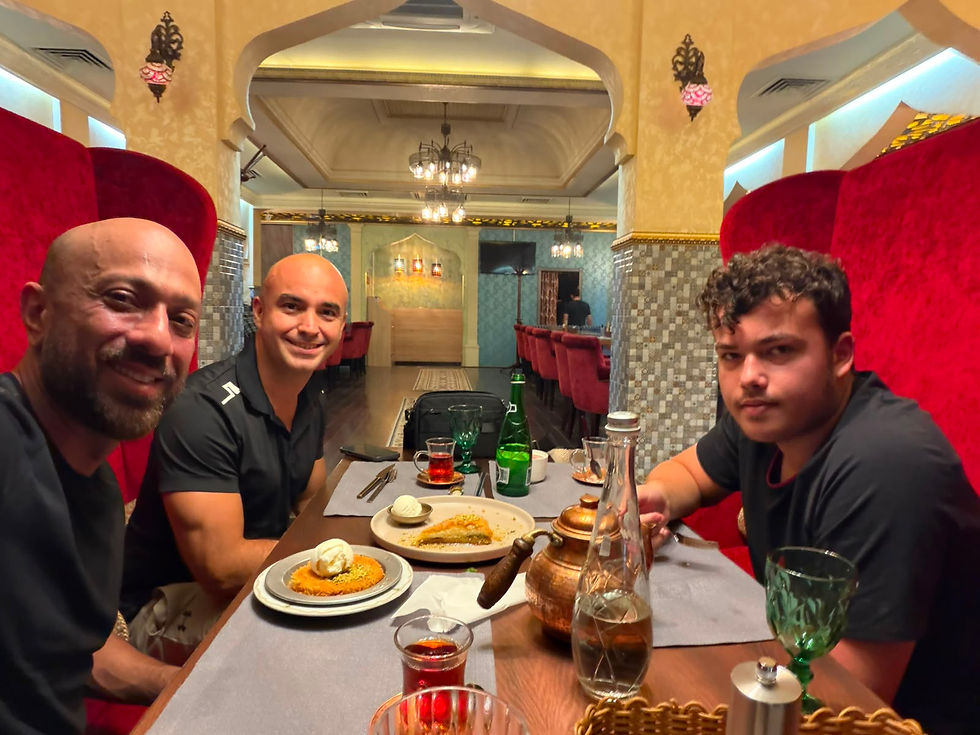
After training, I went home and slept. In the evening I ate kebab and later met Khalid and Hamod. They were going for dessert. Obviously, I joined. We walked around afterwards. Food. Friends. Walking. Home. My days here had become remarkably simple. And remarkably good.
Day 13
Double-training day. Hard again. I trained without shin guards and tried to protect the areas that needed protecting. By now I had become much better at understanding which movements affected my chest and which ones I could still perform properly. After training, Alex and I went for breakfast. A serious breakfast. The kind you earn after spending your morning inside a Dagestan gym. Then I went home and slept. In the evening we had grappling. I’ve grown very fond of the coaches here. The sessions are hard, but there is always something to learn. I’m not interested in simply surviving rounds. I want technique.
Position. Timing. Details. That’s one of the main reasons I came here. After grappling, I met Alex again.
We ate somewhere with live music and spent the evening talking. And somewhere during these days, another change had become obvious. My body was no longer fighting the schedule. It had accepted it. Wake up. Train. Eat. Sleep. Train again. At the beginning of the camp, that rhythm had felt extreme. Now it simply felt like Wednesday.

Day 14
Another wrestling session. Extremely hard. Because of my pectoral injury, I spent much of the session defending and working through the techniques as carefully as possible. Today I also met Hamood, a Pakistani fighter training here in Dagestan.
Young, hungry and promising. That’s one of the interesting things about this place. People come here from everywhere for essentially the same reason.
To improve. Nobody accidentally ends up in Dagestan for an MMA camp. You choose to come here. You choose the discomfort. You choose the hard training.
And once you’re inside the gym, nationality doesn’t matter very much. Everybody understands why everybody else is there.
After training, Alex, Arsen and I wanted to find a good breakfast place. There was one problem. Training here finishes late. By the time we arrived, breakfast service was over.

So breakfast became pizza and lentil soup.
Problem solved. Later, we visited a shop selling Nurmagomedov-related designs. I bought a T-shirt and picked up a few things for my daughter. Then I went home, rested for a while and went back outside.
While walking through a park, I noticed a man selling old objects on the ground. Coins. Pins. Small pieces of history. I bought two badges. One was Soviet-era.
The other was an old Turkey badge connected with a UEFA youth competition from 1984. Probably not particularly valuable. I didn’t care.


I like souvenirs that have a story.
Something you accidentally discover on the ground in a park means more to me than something manufactured specifically for tourists.
I kept walking. Eventually I sat at a café, had some good ice cream and drank coffee. Then somehow my evening ended inside a PlayStation café. Red Alert.
Counter-Strike. For a while, I could have been twenty years younger.


No complicated thoughts.
Just the simple desire to win a game of Counter-Strike.
I could have stayed longer. But even in Dagestan, sleep eventually wins. I went home.
Day 15 — Friday
My final Friday in Dagestan. We trained at a different gym. My chest was still bothering me, so I couldn’t spar properly. And this time I accepted it. Sport has to be viewed long term. There is no point turning a manageable injury into a serious one because your ego wanted another few rounds. So I worked with what I had. Around lunchtime, I found a good croissant and tried a drink that seems popular here: espresso served alongside a cold pomegranate and raspberry mixture. I loved it. Then I went back to rest before the 5 p.m. session. Arsen picked me up around 4:30.
We arrived early. And I felt great. Really great. This was going to be my final wrestling session in Dagestan.
Maybe my body understood that too. For one last session, I almost forgot about the aches. We wrestled hard. And I wrestled well. After nearly two weeks here, something had changed. The pace that had destroyed me during the first week no longer felt impossible.
I could handle the rounds. I recovered faster. I understood when to push and when to conserve energy. The camp hadn't become easier. I had adapted to the camp. And I enjoyed that final session enormously. At the end, we took a big group photo.
Looking at everyone standing there, I realised the photo meant more to me than I had expected.

Not because it proved that I had trained in Dagestan.
I don’t need proof.
It mattered because I knew the people in the photo now.
They weren’t random fighters standing behind me.
They had become part of the experience.
After training, I went home, dropped off my gear and went out for döner.
Nothing glamorous.
Exactly right.
Same Mentality
I came here for MMA.
But somewhere between the training sessions, I found something else that I hadn’t really planned for.
Friendship.
Arsen.
Alex.
Yariq.
Mohamed.
Khalid.
Hamod.
My coaches.
The fighters I trained with.
Different countries.
Different jobs.
Different backgrounds.
Different lives.
But inside the gym, most of those differences become irrelevant.
You train.
You struggle.
You get tired.
You continue.
If someone falls, somebody helps him back up.
Then you keep working.
There isn’t much need to talk about mentality when everyone around you is already living it.
Same mentality.
We are here to get better.
That’s enough.
And maybe that’s why I enjoyed these friendships so much.
I like being alone.
Dagestan didn’t change that.
If anything, it confirmed it.
But being comfortable alone doesn’t mean you don’t value people.
Maybe it actually makes friendship easier.
You’re not spending time with someone because you need them to fill a space.
You’re there because you genuinely enjoy their company.
When I’m alone, my energy comes back.
Then when I meet the guys, I have energy to give.
I joke.
I talk.
I enjoy the moment.
And when the day is over?
We say goodbye.
Everyone goes home.
That’s enough for me.
Day 16 — Saturday
My final weekend.
And finally, I did almost nothing.
I ran.
Then I rested.
A lot.
Honestly, I barely got out of bed.
And it felt incredible.
For two weeks my body had been running on a completely different schedule.
Kickboxing.
Wrestling.
Grappling.
Sparring.
Running.
Mountains.
Doctors.
Massage.
Physiotherapy.
Walking around Makhachkala.
Eat.
Sleep.
Do it again.
Now suddenly there was nothing I had to do.
I stayed in bed and thought:
Dünya varmış.
There isn’t a perfect English translation.
Something like:
So this is what life feels like.
But even that doesn’t quite capture it.
I needed the rest.
The strange part was that underneath the relief, there was already another feeling.
I was going to miss the training.
When Hard Becomes Normal
During the first week, I wondered whether my body could handle this rhythm.
Everything hurt.
My feet were destroyed.
I couldn’t stay awake.
I was permanently hungry.
Then the pectoral injury arrived.
At some point, though, the question changed.
I stopped wondering whether I could handle the rhythm.
It had become my rhythm.
Two sessions a day stopped sounding crazy.
Being exhausted became normal.
Sleeping between sessions became normal.
Eating constantly became normal.
Waking up knowing exactly what I had to do became normal.
And I liked it.
Maybe more than I expected.
There is something addictive about living with such a clear purpose.
There isn’t much room for unnecessary noise when the next few hours have already been decided.
Train.
Recover.
Train again.
Everything else fits around that.
Soon I’ll go back to normal life.
Work.
Meetings.
Phones.
Messages.
Schedules.
Responsibilities.
Training will once again have to fit around life instead of life fitting around training.
And right now, I genuinely don’t know how that is going to feel.
What Dagestan Gave Me
I came here expecting MMA.
Hard training.
Wrestling.
Sparring.
Grappling.
Running in the mountains.
Dagestan delivered all of it.
Plus an injured pectoral, destroyed feet, bruises and a considerably improved ability to fall asleep anywhere.
But those aren’t the things I’ll remember most.
For a couple of weeks, my normal world became very far away.
The internet barely worked sometimes.
Perfect.
My days became simple.
Train.
Eat.
Sleep.
Walk.
Coffee.
Talk.
Repeat.
There was less information coming in.
And less desire to send anything out.
I didn’t feel the need to constantly show where I was or explain what I was doing.
I was simply there.
That felt good.
Very good.
I don’t think I needed to “find myself” here.
I already knew who I was.
Maybe I just needed enough distance from everything else to hear myself clearly again.
And then there were the people.
I came to Dagestan alone.
I was completely comfortable with that.
But I found people I genuinely enjoyed not being alone with.
Maybe that’s one of the best things you can bring home from a trip.
Not dependence.
Connection.
Not needing people around you.
Choosing them.
I came here thinking the difficult part would be adapting to Dagestan.
My body adapted.
My mind adapted.
The hard training became normal.
The simple life became normal.
Even Makhachkala started feeling familiar.
Now there is only one question left.
How am I supposed to go back to normal life after this?
Maybe I had it backwards from the beginning.
Maybe the difficult part won’t be adapting to Dagestan.
Maybe the difficult part will be adapting back.


